
Portugal or Scotland for Your Bucket-List Golf Trip? A Decision Guide for Golfers Over 40
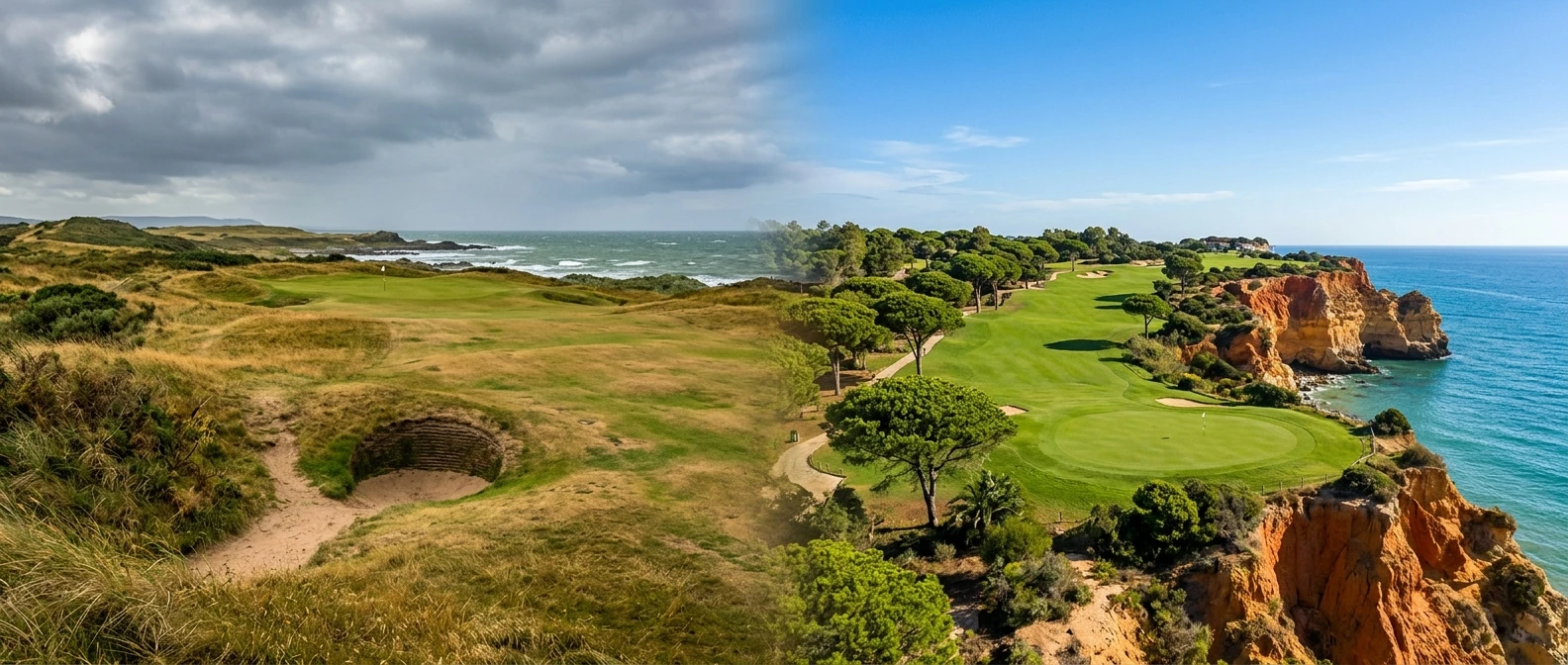
Both countries deliver a bucket-list golf trip, but they suit different golfers. Scotland is the home of the game: firm, wind-exposed links, centuries of history, and rounds that reward patience and imagination. Portugal’s Algarve offers sheltered resort golf, a long season, easy transfers and a trip you can run at a gentler pace.
If you want the most historic golf on earth and can travel between late spring and early autumn, choose Scotland. If you want mild weather, comfort and a wider choice of travel months, choose the Algarve. The sections below cover weather, the golf itself, physical demands and time off the course, so you can see which side of that split you fall on. Planning a Portugal or Scotland golf trip comes down to those four questions.
The short answer: which trip suits which golfer
Scotland suits the golfer who wants the course to be the main event. You play ground where the sport developed, you walk most rounds, and you accept that the weather is part of the deal.
Portugal suits the golfer who wants the whole trip to be comfortable. The courses are well kept, the resorts are built around golf, and the days between rounds are easy to fill with food, wine and sun.
Neither choice is the safe one or the adventurous one in any absolute sense. The right answer depends on when you can travel, how you like to play, and how much effort you want the logistics to take.
Weather and timing: when each destination plays at its best
Weather is the clearest dividing line between the two, and it should be the first question you answer because it decides which months are realistic.
Scotland has a defined season. Late spring through early autumn is when most visitors play, and the summer evenings are very long, so a late afternoon round or a second nine after dinner is a real option. The weather can change quickly at any time of year. Expect to carry full waterproofs, warm layers and a hat even in midsummer, and treat a dry, calm round as a bonus. Winter brings short days and a much more limited golf trip.
Portugal’s Algarve plays across most of the year. Spring and autumn are the comfortable shoulder seasons, with mild temperatures that suit walking or riding a full round. Summer can be hot enough that you will want early tee times and a pool afternoon. Winter is mild by northern European standards, though it is not guaranteed dry.
A practical way to decide:
- If your only free weeks fall outside Scotland’s season, Portugal wins on weather alone.
- If you can travel in summer and want long daylight, Scotland has an advantage the Algarve cannot match.
- If you can travel in spring or autumn, both work, and the decision moves to the style of golf.
Links versus parkland: how the golf itself differs
The two trips give you different games, and it is worth knowing which one you enjoy before you book.
Scottish links golf is played on sandy coastal ground with firm, fast fairways. Wind is the main hazard. The ball runs a long way after landing, bunkers are deep and often small, and the best shot is frequently a low one that rolls onto the green rather than a high one that stops. Scoring depends on reading the bounces and managing the wind, so a good round can come from a modest swing and a sharp head. If you want to understand why the game is shaped the way it is, links play teaches you directly.
Algarve golf is mostly parkland and resort golf. Many courses run through pine trees, along cliff tops or beside lagoons and coastal scrub, and they are generally maintained to a polished standard with softer, more predictable conditions. The ball tends to land and stop. Approach shots work the way most golfers are used to, and the wind matters less than it does in Scotland, although coastal holes can still catch a breeze.
A simple test: if the idea of a ball bouncing sideways off a mound and onto the green sounds like fun, you will enjoy Scotland. If it sounds like an unfair surprise, the Algarve will suit you better. Neither is the harder test of skill in any fixed sense. They ask for different shots.
How hard the trip is on you: walking, transfers and pace
This is the question golfers over 40 often leave until too late, and it shapes how much you enjoy the week.
Walking. Scottish links are usually walked, often with a caddie or a trolley, and the ground can be undulating and exposed to wind, which adds to the effort. A round is a few hours of steady walking in changeable weather. In the Algarve, buggies are widely available at resort courses, so you can choose to walk or ride depending on how your knees, back or hips feel that day. If physical comfort matters, that flexibility counts for a lot.
Transfers. Scotland is a trip of travelling between places. Most visitors fly into Edinburgh or Glasgow and then drive to the courses, and the famous venues are spread across different regions, so a multi-region trip means real road time, often on narrow roads and on the left. A private driver can remove the stress, and our piece on driver or rental car for St Andrews covers that choice in detail. In the Algarve, the resorts and courses cluster around the coast near Faro airport, so you can often unpack once and reach several courses with short drives.
Round-to-round pace. Scotland rewards a schedule with breathing room. Playing 36 holes a day in strong wind is tiring, and tee times at the best-known courses are not flexible, so you plan around them rather than the other way round. The Algarve lets you pace yourself more loosely, with morning rounds, a long lunch and a free afternoon, and with a wider choice of courses if you want to change plans.
If you are travelling with a group, deciding between a private golf tour or a group tour will also affect how much of this pace you control.
What the days off look like: food, wine, whisky and history
You will spend a lot of the trip off the course, and the two countries offer very different ways of doing it.
In Portugal, days off revolve around the table and the coast. Grilled fish and shellfish are staples, and the country’s wines, from crisp whites to the reds of the Douro and Alentejo, are easy to enjoy alongside a long lunch. You can also visit old towns such as Tavira, Lagos or Silves, walk the cliff paths, or take a boat along the coastline. The mood is relaxed and sunny.
In Scotland, days off lean toward history and tasting. Distillery visits are an obvious draw, and golf and whisky pair naturally, as we explain in why golf and whisky make the perfect Scottish holiday. Castles, small coastal towns and old city streets fill the other hours, and good seafood and local produce turn up on many menus. Evenings tend to be spent in a pub or a warm dining room, which is part of the pleasure after a day in the wind.
Couples and mixed groups often find the Algarve easier when not everyone plays, because the resorts offer spas, pools and beaches. Scotland works well too, but the appeal for non-golfers is more cultural and weather-dependent.
Who should choose Portugal, who should choose Scotland, and who should do both
Choose Portugal if:
- Your travel window is outside Scotland’s main season.
- You want to ride or walk as you choose and keep physical effort flexible.
- You prefer parkland-style golf with softer conditions.
- You want one base with short transfers.
- You are travelling with non-golfers who want sun, pools and long lunches.
Choose Scotland if:
- You want to play the courses where the game’s history was made.
- You enjoy links golf and the creativity that wind and firm ground demand.
- You can travel between late spring and early autumn.
- You are comfortable with changeable weather and more road time.
- Whisky, castles and old towns appeal as much as the golf.
Do both if you have the time and budget for two trips, which most golfers eventually do. A common order is to start with whichever matches your current fitness and calendar, then use the second trip to try the other style of golf. Taking Portugal in a shoulder season and Scotland in summer is an easy way to space them out. Playing links golf after a trip to the Algarve also gives you a clear sense of how different the two games are.
Where to go next once you have chosen
Once you have settled on a destination, the next job is turning the choice into a plan: where to stay, which courses to book first, and how to order the bookings so tee times and accommodation line up.
If you chose Portugal, start with our guide to luxury golf in the Algarve, which covers where to stay, where to play and when to go. If you chose Scotland, read how to book a luxury golf trip to Scotland, which sets out the booking order that works.
When you are ready to compare real options, look at golf travel packages through our booking partners. A package can simplify transfers, tee times and accommodation into one itinerary, which suits a premium trip where you want the details handled.
Related Post

The Influence Of Callaway Golf On Destination Golf Experiences
When you picture the ultimate golfing getaway, you’re likely imagining lush courses, challenging fairways, and [...]