
Caddies, Cars and Tips: The Unwritten Rules of a Golf Trip to Ireland
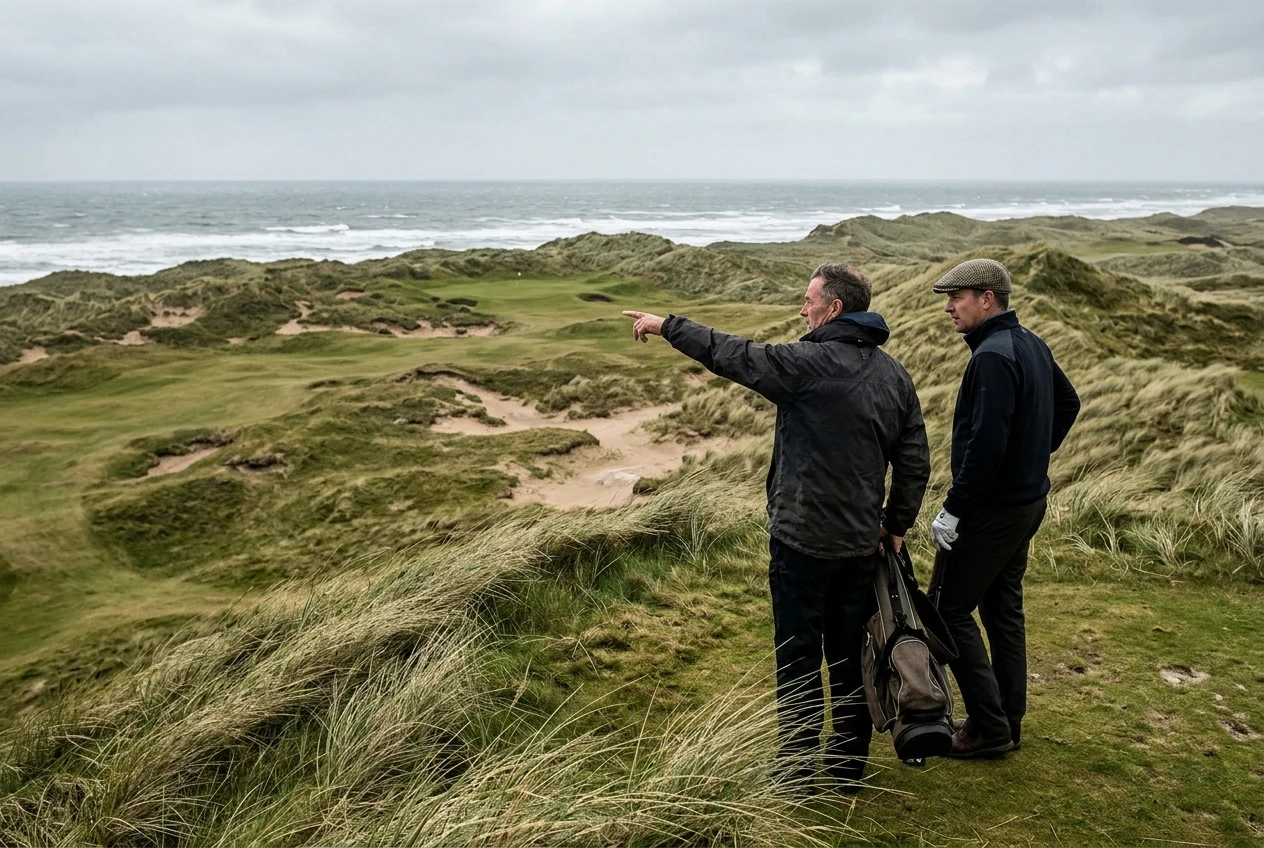
Most Ireland golf trip tips cover which courses to play. Fewer explain how the days work: whether to hire a caddie, how you get from one links to the next, and who gets tipped and when. Those three decisions shape the trip as much as the course list does, and they are easier to settle before you leave than at the first tee.
Do you need a caddie in Ireland? When it’s worth booking one and when a trolley will do
A caddie is worth booking at a links course you may only play once. Links golf is full of blind shots, firm and uneven ground, and wind that changes the right club from hole to hole. A caddie who plays the course daily can tell you where to aim over a hidden fairway and which side of a green to avoid. On a first visit, that local knowledge is part of what the round is for.
A trolley or a buggy suits other rounds. If a day on your itinerary is a relaxed parkland round, or you have already played three links days in a row and want to switch off, carrying or pulling your own bag is perfectly normal. Some courses restrict buggies or reserve them for players who need them, so check the club’s policy when you book.
Some practical points:
- Caddie availability varies by course and by season, so ask when you request your tee time rather than on arrival.
- Caddies are usually booked per player or per pair. Ask which applies at each club.
- If your group is a four, ask how caddies are allocated. Sharing is common at some clubs.
Choose caddies for the courses that are the reason you came, and keep the other days flexible.
How to get the most from your caddie before you reach the first tee
The first few minutes decide how useful your caddie will be. Introduce yourself, say roughly what your handicap is, and tell them how far you hit your clubs on a normal day. A caddie can only give you good yardages and club advice if they know what you actually do, not what you wish you did.
Tell them what kind of round you want. Some players want every line and distance; others want to be told only when a decision is tricky. Both are fine, and a good caddie adjusts once they know.
Then listen to them on the course. If a caddie says to aim at a bunker’s left edge and the ball finishes right of the green, remember that they have watched that shot played many times. Ask questions about green speed and about what the wind will do on the back nine. Ask about the area too, since many caddies are happy to point out a good place for lunch or a pub worth finding.
Hand over your bag with the clubs sorted and a spare glove and towel where they can reach them. Small courtesies like this make the round smoother for both of you.
Tipping on the course, at the hotel and in the pub: what’s customary and what’s optional
Tipping in Ireland is generally more modest than many American visitors expect, and it works differently in each setting. The honest advice is to ask your booking partner or the club what the current norms are, since fees and expectations change.
Caddies. A caddie fee is normally agreed in advance, and a tip on top is customary for good service. Many golfers settle up in cash at the end of the round, so carry some euros (or pounds sterling if any of your rounds are in Northern Ireland, which uses a different currency). Ask the pro shop about the fee and about how tips are usually handled so you are not guessing at the end.
Hotels and resorts. Porters and housekeeping staff appreciate a tip but do not expect large amounts. A small gratuity for luggage help or a particularly helpful concierge is plenty. If you have a driver for several days, a tip at the end is customary when service has been good.
Restaurants. Check the bill for a service charge before adding anything. Some restaurants add one for larger groups, and doubling up is easy to do by accident. If no charge has been added and the service was good, a tip is welcome, though it is a thank-you rather than an obligation.
Pubs. Drinks ordered at the bar are not usually tipped in the way they are in the United States. Buying the barman a drink or leaving a little change is the traditional gesture. For table service with food, treat it like a restaurant.
Getting around: private driver, hired car or transfers, and who each suits
There are three workable ways to move between courses, and they suit different travelers.
A private driver is the most relaxed option and the usual choice for premium trips. Your clubs, luggage and group travel together, nobody has to concentrate on unfamiliar roads, and everyone can enjoy a drink after the round. A good driver also knows the local routes and where to stop. The cost is higher than other options, but it is easier to justify when you split it across a foursome. If you are weighing this against a fully guided option, our comparison of private and group golf tours covers how the two compare.
A hired car gives you the most freedom and suits confident drivers who like setting their own schedule. It works best for a trip based in one area, with short drives between courses.
Transfers (pre-booked car or minibus journeys between specific points) sit in the middle. They suit trips with two or three long moves, such as airport to resort or one region to the next, where you want the stress removed from the long days but are happy to manage shorter hops yourself.
A quick way to choose: if your group is four or more and the itinerary covers several regions, a driver is hard to beat. For a couple staying in one base for a week, a hired car or a few well-timed transfers may be enough.
Driving on the left on narrow roads: an honest look at whether you want to
Irish drivers keep to the left, and many visitors adapt within a day. The harder part is the roads. Rural routes near the coast, where many of the best links sit, can be narrow, with walls or hedges close on both sides and little room to pass oncoming traffic. Drivers pull into gaps and give way to each other, which takes some getting used to.
Ask yourself a few questions before you commit to a hired car:
- Are you comfortable driving a manual gearbox? Automatic cars are available but are often fewer in number, so book early if you need one.
- Will you be driving after a long flight, or after a full round in wind and rain?
- Is there a designated driver who is happy to skip the post-round drink?
- Do you mind driving with clubs and luggage filling the boot?
If the answers make you hesitate, that is useful information. Many golfers find the trip is more enjoyable when someone else handles the driving. If you do hire a car, plan shorter drives, avoid arriving at a new base after dark when you can, and allow extra time for every journey. Drive times between courses in the southwest are covered in our guide to planning a multi-course trip to southwest Ireland.
Booking caddies, tee times and transfers in the right order
The sequence matters because each booking depends on the one before it.
- Tee times at the courses you most want to play. These are the hardest to get and they set your dates. Everything else follows from them.
- Accommodation near those courses. Once you know the days, you can choose where to sleep so that drives between rounds stay short.
- Transfers or a driver. With tee times and hotels confirmed, your routes are fixed and a driver can be quoted accurately.
- Caddies. Request them when you book the tee times, or as soon after as the club allows, and confirm the number you need.
- Dinners and extras. Restaurant tables at popular places fill up, but they are the easiest to adjust.
Book flights once your tee times are confirmed, or at least once your dates are firm. For a broader look at planning across regions, see our guide to a luxury golf trip to Ireland, region by region.
Small details that make the trip run smoothly: weather, pace of play and clubhouse manners
Weather. Irish weather can change within a single round. Pack waterproof jackets and trousers, a spare glove or two, and layers you can add or remove. Bring a warm hat and a dry towel, and keep spare socks in the bag. Courses rarely close for ordinary rain, so expect to play through it.
Pace of play. Clubs expect groups to keep up with the group ahead. Pick up when you are out of a hole, play ready golf, and leave your bag near the next tee. Your caddie will also help keep things moving, since they know how the course flows.
Clubhouse manners. Dress codes differ from club to club, and some dining rooms ask for collared shirts or a jacket in the evening. Check the club’s guidance in your booking confirmation. Phones are often asked to be silent or kept out of certain rooms. Take off hats indoors, and wipe your shoes before you go in.
Time on arrival. Arrive well before your tee time to check in, warm up and meet your caddie. Rushing to the first tee makes for a worse first few holes.
Ready to turn this into a real trip?
Compare Ireland golf packages and tee times through our booking partners, with caddies and transfers arranged in advance, and start with the courses on your list.
Related Post