
Private Guide or Self-Drive for a Scandinavian Golf Trip? Let Your Itinerary Decide
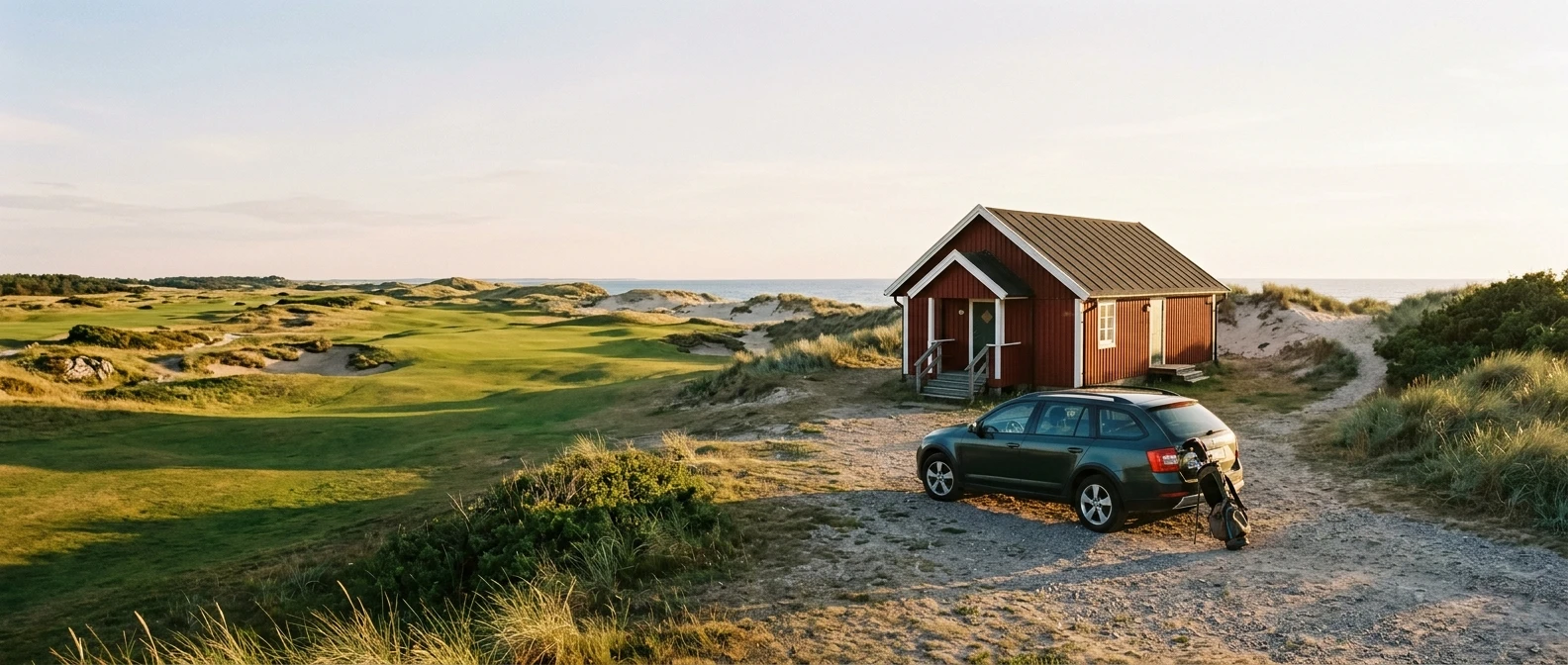
If you are planning a golf trip to Sweden, Denmark or Norway after Scotland or Ireland, the self-drive or private guide decision looks different here. Scotland packs famous courses into a small area with well-worn visitor routes. Scandinavia spreads its best golf across several regions, with bridges, ferries and sometimes a flight between them. Your itinerary should decide how much help you book, not a general preference for independence or luxury.
The four levels of service on a Scandinavian golf trip
Think of a spectrum with four points rather than a choice between two.
- Fully self-drive. You rent the car, book the hotels, reserve the tee times and navigate yourself.
- Self-drive with pre-booked tee times. You still drive, but someone else arranges the rounds, confirms visitor access and sends a day-by-day plan.
- Private driver. A driver handles every transfer between hotels and clubs, and you handle the golf.
- Full private guide. A person who knows the clubs and the region travels with you, drives, and manages the details of each day.
Each step up removes a category of effort. Moving from the first to the second removes the risk of missing a tee time. Moving to the third removes the driving, parking and navigation. The fourth adds local knowledge and relationships on top. Most golfers over 40 land on the second or fourth level, and the rest of this piece explains why.
What a guide actually does that a driver and a good itinerary do not
A driver gets you to the first tee on time. A good itinerary tells you where to be and when. Neither can respond when something changes.
A guide can. If a storm moves through the morning of a round, a guide can call the club, move the tee time if the club allows it, and rework the rest of the day. A guide who knows a club can also explain how the course plays, what the local rules are and where the members drink afterwards. A guide can speak with the starter or the club secretary on your behalf, which matters at clubs that are not set up for international visitors.
Guiding also covers pace. Someone is watching the group’s energy, the weather and the clock, and adjusting. An itinerary is a fixed plan, and a driver follows it. A guide treats it as a draft that can change as the trip goes on.
That difference matters most on a trip with many moving parts. On a one-base trip with three courses nearby, it matters much less.
Where self-drive works well: compact itineraries, one base and courses close together
Self-drive suits golfers who want to unpack once and play within a short radius. Roads in Sweden, Denmark and Norway are well maintained and signposted, and driving is on the right, which is easy for North American visitors and a small adjustment for those coming from Britain or Ireland.
The strongest self-drive case has three features:
- One hotel or resort for the whole stay, or two at most.
- Courses within a comfortable drive of that base, so no round is followed by a long transfer.
- Tee times that you or a booking partner have confirmed in advance.
If your plan looks like that, a rental car and a well-built itinerary may be all the help you need. A regional base, such as the southwest of Sweden or the area around Copenhagen, can give you several quality rounds without much driving. If you are still deciding between those two countries, our comparison of Sweden or Denmark for your golf trip covers the courses themselves. This piece stays on the logistics.
Where self-drive gets harder: long transfers, ferries and bridges, and tee times you cannot move
The picture changes when the itinerary crosses regions. Distances between Scandinavian golf areas can be long, and the route may include a bridge, a ferry or a toll. Crossing between Denmark and Sweden, for example, means using a bridge or a short ferry, and you need to know which one fits your schedule. In Norway, geography adds more: fjords, mountain roads and water crossings can make a short distance on the map a long drive in practice.
None of this is hard on its own. The difficulty comes from stacking it onto a fixed tee time. A ferry that runs late or a road closed for works can turn a relaxed morning into a rush to a club that will not hold your slot. Many private and member clubs give visitors only certain windows, and those slots are often hard to rebook once missed.
If your trip has several long transfers and several fixed tee times, the risk of self-drive is not that you will get lost. It is that one delay can cost a round you planned the whole trip around. A driver or guide absorbs that risk. They watch the schedule, leave margin, and know the alternatives.
Club access and etiquette: when a local host opens doors and when the pro shop is enough
Some clubs in Scandinavia take visitors as a matter of routine. You contact the pro shop or book online, confirm your handicap, pay the green fee and play. For those clubs, the pro shop is enough, and a guide adds little.
Others work differently. Some clubs ask for proof of handicap, and some restrict visitor times or require an introduction or a member’s invitation. Rules vary by club, so check each one directly rather than assuming. This is where a local host or an experienced booking partner earns their fee, because they know which clubs ask what and how to approach them.
Etiquette is mostly familiar to anyone who has played in Scotland or Ireland: arrive early, dress to the club’s code, keep pace and repair the course. Clubs with a more formal culture may have expectations around the clubhouse, so ask when you book. A guide can brief the group before you arrive, which spares you the awkwardness of finding out at the door.
Daylight, pace and fatigue: planning rounds and drive days so you still enjoy the evening
Long summer daylight is one of the real pleasures of golf in northern Europe. It also tempts groups to overschedule. When the light lasts well into the evening, 36 holes plus a long transfer starts to look possible. Possible and enjoyable are different things.
A few planning habits keep the trip comfortable:
- Avoid pairing a long transfer day with a demanding round. Play shorter or easier courses on travel days.
- Leave a gap between arrival and the first tee time, especially after an overnight flight.
- Schedule a lighter day after every two or three rounds, particularly for groups with a wide age range.
- Plan dinner reservations around the end of the round, not the other way round.
If you drive yourself, you are the driver after four or five hours on the course, in a country where you do not know the roads. That is a fatigue cost worth counting. Having a driver or guide behind the wheel means you can finish the round, have a drink and arrive at the hotel rested enough to enjoy dinner.
Your group and your game: couples, four-balls, mixed handicaps and non-golfing partners
The right level of service depends heavily on who is travelling.
Couples who both play can manage self-drive on a compact plan. If one of you does all the driving, ask whether that is the trip you want.
A four-ball of friends often benefits from a private driver or guide for practical reasons. One vehicle holds the group and the clubs, and nobody has to stay sober enough to drive. A larger group also makes the cost per person of a driver or guide lower.
Mixed handicaps affect tee choices and pace. A guide who knows the courses can suggest which tees and which layouts suit each player, so the stronger players are tested and the others are not worn down.
A non-golfing partner changes the whole plan. They need things to do on the days you play and a sensible way to get there. A driver or guide can arrange sightseeing, a spa visit or a city day, and move between the two. In self-drive, one car cannot be in two places.
A simple way to choose: five questions to ask before you book anything
Answer these before you compare packages.
- How many regions will you cover? One base points toward self-drive. Three or more regions point toward a driver or guide.
- How many tee times are fixed and hard to move? The more you have, the more a delay costs, and the stronger the case for help.
- Do any of your target clubs need an introduction or a handicap certificate? If so, a host or booking partner with local contacts is worth considering.
- Who is in the group? A larger group, a mixed-ability group or a non-golfing partner all favor a driver or guide.
- How much of the trip do you want to spend planning and navigating? If the honest answer is “as little as possible,” move one level up from where you started.
If you answered mostly “one base, flexible times, open clubs, a simple group,” start with self-drive and pre-booked tee times. If you answered the other way on most, a private driver or full private guide is likely to give you a better trip. A mixed set of answers usually points to the middle: self-drive for the compact stretch, a driver or guide for the long transfers.
For a wider look at how the region compares with other destinations, see our guide to golf in Scandinavia for the serious golfer who has already done Scotland.
Ready to price it out? Compare private-guided and self-drive Scandinavian golf packages through our booking partners and book the level of service that fits your trip.
Related Post

Planning A Multi-destination Golf Trip Process
Planning a multi-destination golf trip is kind of like putting together a big puzzle. Each [...]
How Long Until You Make Your First Dollar Online? An Honest Answer
Anyone who tells you exactly how long it takes to make money online is guessing, [...]