
Golf in Scandinavia and the Baltics for the Serious Golfer Who Has Already Done Scotland
Once you have played the Old Course and a few of its neighbours, the question changes. You are no longer asking which famous course to tick off. You are asking where a trip would feel different enough to justify the flights, the planning and the cost. Golf in Scandinavia is one answer worth testing, and it deserves an honest look rather than a sales pitch.
What a serious golfer is really looking for beyond the usual destinations
After Scotland, most experienced golfers want one of three things: a different kind of golf, a different kind of trip, or both. Repeating the same links experience somewhere else rarely satisfies any of them.
Northern Europe offers a different kind of golf and a different kind of day. It does not offer a second Scotland. If your priority is firm, wind-blown ground-game golf on centuries-old turf, you will find only a small amount of it here, and the rest of this article says where. If you want quiet courses, forest settings, long evenings and a city stay worth the trip on its own, the region becomes much more interesting.
A useful test before you go any further: write down what you valued most on your Scotland trip. If the answer is the golf itself, with its history and its wind, treat Northern Europe as a complement. If the answer is the atmosphere of the whole week, it may suit you better than you expect.
Playing in the long northern light: what the season and the daylight change about a golf day
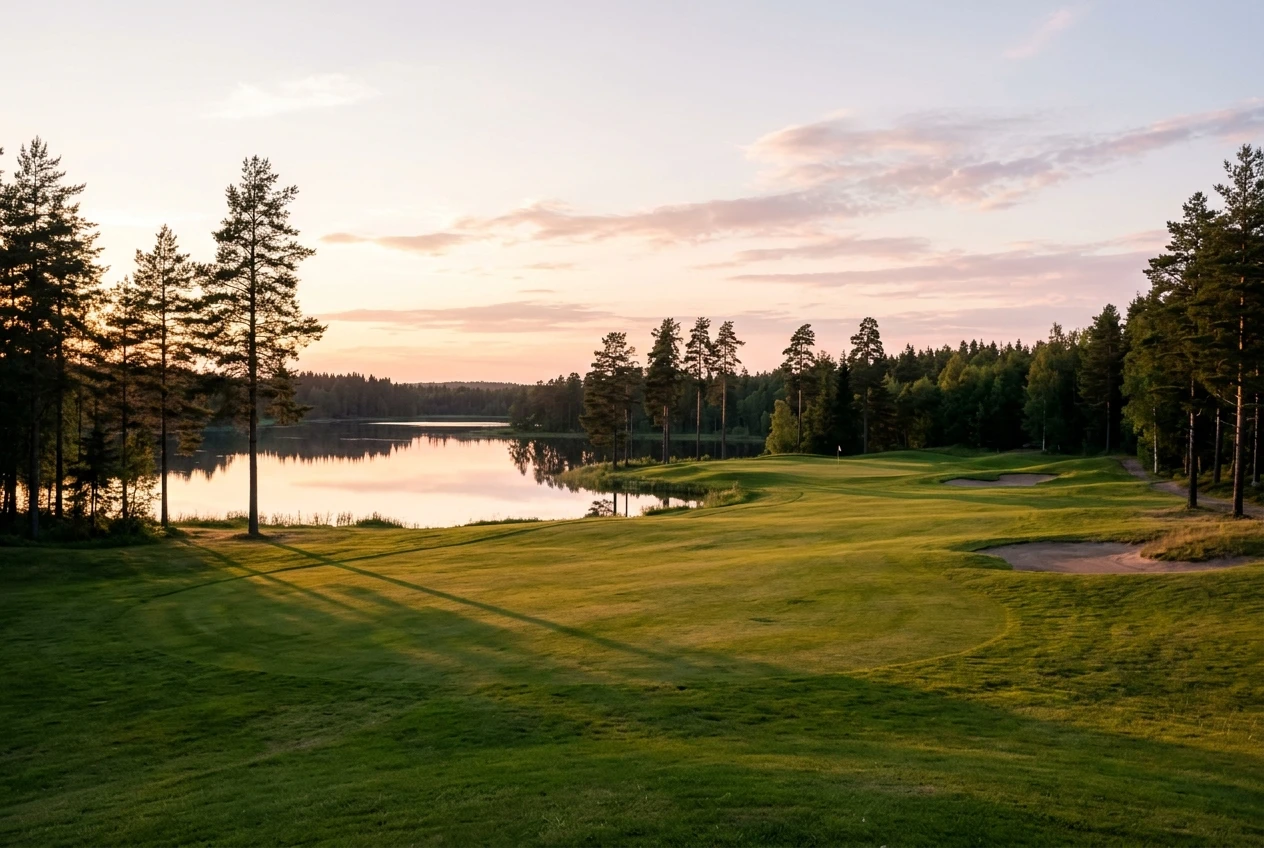
The defining feature of the region is its summer light. Around midsummer, evenings in much of Sweden, Denmark and southern Norway and Finland stay bright until about 10 pm, and the sky does not fully darken in the northern parts. Further north, above the Arctic Circle, the sun does not set for a stretch of weeks. Some courses there advertise midnight rounds, and the Green Zone course on the Swedish and Finnish border near Tornio and Haparanda is the best-known example.
That changes how a day is built:
- You can play a late afternoon round after a morning in the city and still finish in good light.
- A single day can hold 36 holes without rushing, or a long lunch between nines.
- Early tee times matter less, which helps if your group is jet-lagged or includes players who do not like a 7 am start.
The trade-off is a short season. Courses in the region typically open in spring and close by autumn, and the exact dates depend on the weather and on the course. Southern Sweden and Denmark generally have the longer window, and the north has the shortest. Winter closures are normal, and snow or frost can shift opening dates from year to year. Check the specific course’s opening dates for your travel window before you commit to anything.
Summer also brings cooler temperatures than the Mediterranean, which many golfers over 40 find easier to walk in. Pack layers anyway, since a northern evening can turn cold quickly, and rain is a normal part of a trip.
Parkland, forest and coastal golf: how Scandinavian courses play compared with Scotland’s links
The most common Scandinavian course is parkland or forest golf. Fairways run between pine, birch and spruce, often around lakes, with greens that are usually receptive and soft compared with a links. The ball tends to stop where it lands, so you play to carries and angles rather than to bounces and run-outs.
That favours a particular kind of player. Accuracy off the tee matters more than creative shot-making, and a good iron game is rewarded. Wind is a smaller factor inland than on a links, though it still has its say on open or coastal holes. Players who enjoy the lower-running shots that links golf demands will use those less often.
Coastal golf does exist. Falsterbo, on the southwestern tip of Sweden, is the name most often raised when golfers ask about links-style play in the region, with its sea exposure and wind. Parts of the Danish coastline also offer seaside holes. Describe these accurately to yourself before you book: they are coastal courses with some links features, and each one sits somewhere along a spectrum. Ask the booking partner or the club how the course plays, what the turf is like and how firm it runs in the month you plan to visit, rather than assuming from the word “links” on a website.
The honest summary is that Scandinavia will not replace Scotland’s links, and the better question is whether parkland and forest golf in beautiful settings appeals to you for its own qualities.
Sweden, Denmark, Norway or Finland: choosing a Scandinavian base for a first trip
For a first trip, pick one country and one or two bases rather than trying to cover the map. Distances are long and the courses are spread out.
Sweden has the largest golf culture of the four, and the broadest choice of courses around Stockholm, Gothenburg and the south. Bro Hof Slott, outside Stockholm, is one of the country’s best-known modern venues. It makes a reasonable anchor for a first visit that combines a capital city with serious golf. Southern Sweden, around Malmö and the Falsterbo peninsula, pairs well with Copenhagen.
Denmark is the easiest for a short trip. It is compact, well connected by train and car, and Copenhagen gives you a high-quality city stay with courses within reach. The season is on the longer side for the region, and the coastal terrain gives a taste of seaside play.
Norway has dramatic scenery, but courses are fewer and often tied to a short season, and costs for travel and dining can be high. It suits a golfer who values the landscape as much as the round and is comfortable with more logistics.
Finland is the choice for a distinctive experience, especially for the midnight sun in the north. It asks for more planning and tends to suit a second or third northern trip rather than a first.
If you want one recommendation for a first visit, southern Sweden with Copenhagen or Stockholm as the city anchor gives the most choice with the least friction. Treat that as a starting point to discuss with a booking partner, who can confirm what is open and bookable for your dates.
The Baltics in brief: what Estonia, Latvia and Lithuania offer and what to check before you commit
Estonia, Latvia and Lithuania have a smaller and younger golf scene than the Nordic countries. Each has a handful of courses, usually near the capitals of Tallinn, Riga and Vilnius, and the appeal is as much the old towns and the value of a city break as the golf.
That makes the Baltics better as an add-on than as a main event, at least for a golfer coming from Scotland. A few things to check before you commit:
- Opening dates and course condition. The season is short, and conditioning varies more between courses than it does in established golf regions.
- Access for visitors. Confirm that visitors can book tee times, whether a member or club introduction is needed, and whether there are group minimums.
- Rental clubs and facilities. If you do not want to fly with your own clubs, check what is available and in what quality.
- Transfers. Distances between courses and between cities can be long, and public transport rarely works with golf bags and tee times.
- Flight connections. Direct routes depend on your departure city, so confirm them early.
Treat the Baltics as a possible second leg of a Northern Europe trip, and ask a booking partner which courses they can confirm for your dates.
How a Northern Europe trip compares with Scotland and Portugal
Scotland gives you links heritage, history and the feeling of playing where the game developed. If you want to plan or revisit that side, our guide to Scotland golf tours covers how to choose among them.
Portugal offers a longer season, reliable weather, resort-style golf and a strong food and wine scene. If you are choosing between those two, our Portugal or Scotland decision guide sets out how they differ for golfers over 40.
Northern Europe sits somewhere else on the map. Compared with both:
- Season: the shortest of the three, with summer as the main window.
- Golf style: mostly parkland and forest, with limited coastal options, and not Scotland’s links.
- Daylight: the best of the three in summer, which changes how you schedule a day.
- Weather: cooler and less predictable than Portugal.
- Feel: quieter and less famous, with fewer bucket-list names to collect.
If your priority is guaranteed sun or famous venues, Portugal and Scotland remain the stronger choices. Northern Europe makes sense when you want novelty, long evenings and a trip that combines golf with some of the region’s most liveable cities.
Building the trip: pairing golf with cities, food and downtime, and what to ask a booking partner before you pay
A good Northern Europe trip balances golf days with city time. A common shape is three to four rounds spread over a week, with the rest of the time given to museums, waterfront walks, dining and rest. The long evenings help here, since you can golf and still have an unhurried dinner.
Food in the region is a draw in its own right, with a strong tradition of seafood, rye bread, dairy and seasonal produce. Book restaurants early for the summer months, as popular places fill quickly.
Before you pay a deposit, put these questions to any booking partner:
- Which courses are confirmed for my dates, and which are only likely to be open?
- What is the course condition normally like in that month?
- How are transfers handled, and how long are the drives between courses and hotels?
- What is the cancellation policy if weather or an early course closure disrupts a round?
- Are tee times guaranteed in writing, and what happens if one is lost?
- What is included in the price, and what is extra: green fees, caddies, rental clubs, meals?
- How would you structure the itinerary around the daylight I want, such as late rounds or two-round days?
A partner who answers these clearly and in writing is usually worth more than one who offers the lowest headline price.
If a Northern Europe round is tempting you, ask one of our golf travel booking partners to price an itinerary for your dates and group size, built around the daylight and season you prefer.
Related Post
Where to Stay at Bandon Dunes, and How to Get a Premium Trip Without the Fuss
Bandon Dunes sits on the Oregon coast, and its reputation rests on the golf. Its [...]
Where to Start Online When You Know Nothing Yet
Starting online as a beginner is hard mostly because nobody tells you what to do [...]