
Golf in the Baltics Country by Country, and Where to Stay for a Premium Trip in Each
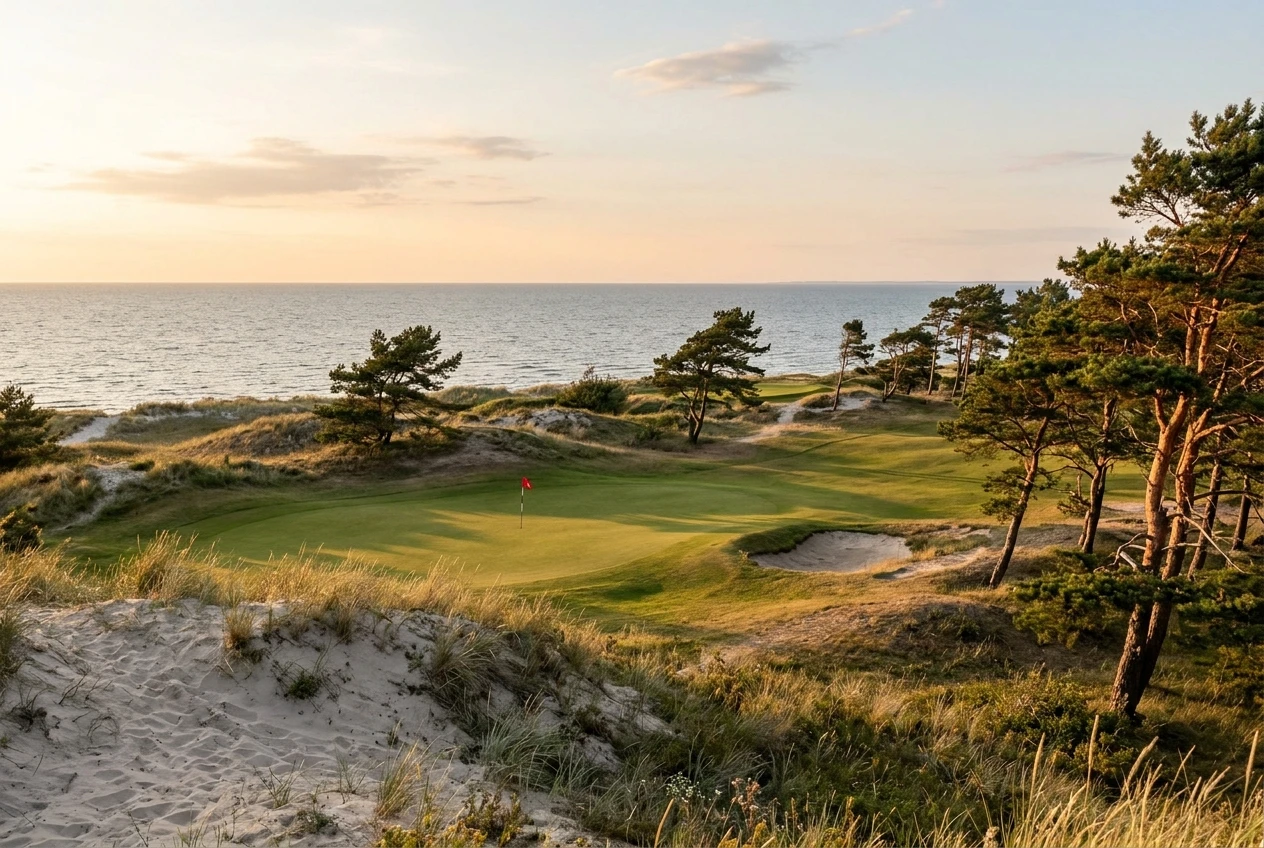
Golf in the Baltics rewards a particular kind of planning. The three countries are compact, the capitals are polished and easy to enjoy, and the courses are in a different place from the best hotels. Where you sleep matters more than which course you pick, because your base decides how long you spend in a car each day.
This guide goes country by country and asks one question of each: how far is a luxury stay from the golf, and is that distance worth it?
Why the Baltics suit a golfer who wants something new but still wants comfort
If you have already played the classic destinations, the appeal here is how little the trip resembles them. Tallinn’s medieval old town, Riga’s Art Nouveau streets and Vilnius’s baroque centre are all UNESCO-listed, so the evenings are as good as the rounds. All three countries use the euro and sit inside the Schengen area, which keeps money and border logistics simple.
The trade-off is that the golf scene is younger and smaller than in Scotland, Portugal or Spain. You will not find a dense strip of resorts where every hotel has a course at the door. That is why choosing a base deliberately is the most useful decision you will make.
Estonia: choosing between a Tallinn base and a coastal stay for your rounds
Tallinn is the easiest of the three to build a trip around. The old town and the surrounding districts have the strongest choice of upscale hotels, restaurants and spas, and the airport is close to the centre. Courses near the capital can generally be reached with a short transfer, so a city hotel works well if you want one or two rounds in a trip that is mostly sightseeing and dining.
The alternative is a coastal stay. Pärnu, a seaside town southwest of Tallinn on the Gulf of Riga, is one coastal option worth looking at. It suits a group that wants to play several rounds in a row and would rather sleep near the course than commute from the capital. The cost is a longer journey at each end and fewer city evenings.
Before you commit, check three things:
- The transfer time from your hotel to the first tee, door to door.
- Whether the course takes visitor bookings online or needs an email or phone request.
- Whether the hotel can arrange a driver, or whether you need to book one separately.
If your group splits between golfers and non-golfers, Tallinn is the safer choice. Non-players have plenty to do, and the golfers lose only a short drive.
Latvia: Riga as a luxury base and how far the courses sit from it
Riga is the most cosmopolitan of the three capitals and has a deep list of premium hotels, from restored historic buildings in the old town to larger international-brand properties. For a golfer over 40 who values a good dinner and a quiet room after a round, it is a strong base.
The question to ask is how far the course sits from the city. Latvian golf is generally oriented around Riga and its surroundings, but distances and transfer times vary from one course to the next. Look at a map and a booking partner’s transfer estimate before you choose a hotel, rather than assuming everything is close.
Riga also sits roughly between Tallinn and Vilnius, which makes it a natural middle stop if you want to play more than one country. A hotel in the centre keeps that option open, and the airport connects to the other capitals.
If you prefer a resort-style stay, look at properties outside the city that combine a course, a spa and on-site dining. You give up the old town, and in return you can walk from breakfast to the tee. This works best for groups of golfers who want to play most days and treat the hotel as the main event.
Lithuania: Vilnius hotels, nearby courses and what to check before you book
Vilnius has a compact baroque old town, with boutique hotels in restored buildings and larger luxury properties a few minutes’ walk away. It is a pleasant place to return to after a day on the course, and it is easy to walk around without a car.
Lithuania has the fewest well-known golf options of the three, so more of your planning is verification. Before you book a hotel in Vilnius, confirm these points:
- Which courses you can actually reach from the city, and how long the drive takes.
- Whether visitors can book tee times directly or need a booking partner to arrange them.
- What the course’s opening dates are, because some close for the colder months.
- Whether rental clubs, buggies and caddies are available if you are travelling light.
None of this is hard, but it is easier to settle before you pay for a hotel than after. A short phone or email exchange with the course is often worth the effort in a market where information online can be thin.
Resort stay or city hotel plus transfers? How to decide for your group
Both models work in the Baltics, and the right one depends on who is travelling.
Choose a city hotel with transfers if:
- Your group includes non-golfers who want museums, restaurants and shopping.
- You plan to play two or three rounds in a week rather than every day.
- You like having a choice of dinner venues each night.
- You would like to compare more than one course from the same base.
Choose a resort-style stay if:
- Everyone in the group plays, and plays often.
- You want early or late tee times without coordinating a driver.
- You value a spa, a quiet setting and on-site dining over city life.
- You want to reduce the number of moving parts to a minimum.
A mixed approach also works: a few nights in a capital, then a few at a resort or coastal base. It adds one transfer, but it gives you both kinds of trip. For a group of four or more, a private driver for the whole stay often costs less per person than it sounds, and it removes the risk of a missed tee time.
Getting around: flights between the three capitals, drivers and tee time etiquette
Short flights connect the three capitals, but schedules change, and direct routes between them are not guaranteed on every day. Check current timetables when you plan, and book the flights around your tee times rather than the other way round. The alternative is a road transfer, which is comfortable with a private driver but is a long day if you cover the whole distance in one go. A common approach is to pick one country as the base, play there, and cross to a second country only if you have enough days to make the move worthwhile.
For getting to the course, a private driver is usually less stressful than a rental car, especially if you are unfamiliar with local signage and parking. It also means nobody has to skip the post-round drink.
A few habits make the whole experience smoother:
- Arrive well before your tee time, and allow for check-in and payment.
- Carry proof of handicap if the course asks for it. Some request it, and it costs nothing to have ready.
- Follow the course dress code, which is usually conventional golf attire.
- Keep pace of play moving. Courses in smaller golf markets tend to appreciate visitors who respect the course and the staff.
- Confirm your booking a day or two ahead, particularly outside peak weeks.
When the season runs and how to time a trip around it
Golf in Northern Europe is seasonal. The playing season generally runs from late spring into early autumn, and courses in the region may close or limit play when there is snow or frost. Exact opening and closing dates vary by course, so confirm them directly rather than relying on a general rule.
Summer has one particular advantage. Days are very long around Midsummer, which means you can fit a late round into the evening and still have daylight left. Spring and early autumn are quieter and cooler, and they can suit golfers who prefer a calmer pace and lower crowds.
It is late November now, so you have time to plan a trip for the 2027 season. Booking early gives you the widest choice of hotels and tee times, particularly in the capitals during the peak summer weeks.
Pairing the Baltics with a wider Nordic trip
The Baltic capitals are close to the Nordic region, and a short ferry crossing links Tallinn with Helsinki. That makes it practical to combine a Baltic base with a Finnish or wider Scandinavian leg. If you want to see how the Baltics fit into a bigger itinerary, our guide to golf in Scandinavia and the Baltics for the serious golfer covers the wider region and how to link the countries.
Ready to shape your Baltic trip? Check tee time availability and golf-friendly hotel options through our booking partners for the country you want to start with.
Related Post

Looking Ahead: Predictions And Favourites For The Next Genesis Scottish Open
The Genesis Scottish Open stands tall on the global golf calendar, blending Scottish links tradition [...]